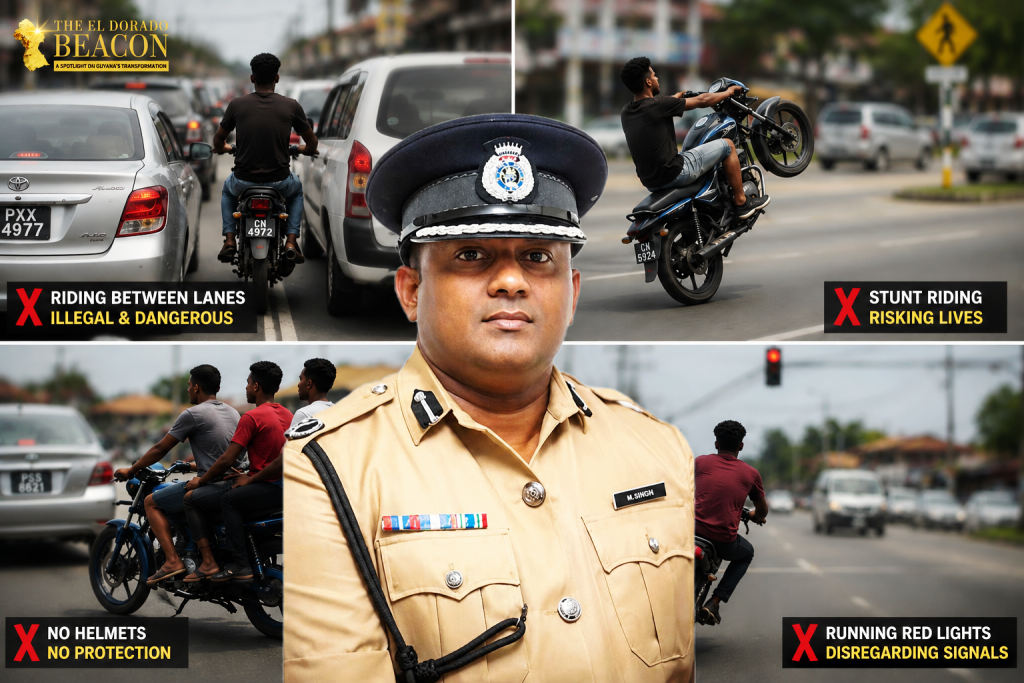
Traffic Chief Assistant Commissioner of Police Mahendra Singh has rejected ignorance as an excuse for motorcycle users who fail to use the roadways properly, stressing that licensed riders are expected to know and obey the traffic laws.
Speaking with The El Dorado Beacon, the Traffic Chief pointed out that almost all motorcycle users are licensed, meaning they would have been required to study and understand the rules of the road, pass a written examination and successfully complete a practical assessment before being authorised to operate a motorcycle.
Against this background, he maintained that riders cannot claim that they are unaware of where and how they are expected to use the roadways.
The Traffic Chief further stated that riders are fully aware of the dangers associated with operating motorcycles without the required safety gear, as well as the legal consequences of doing so.
He noted that despite the risk of being charged with such offences, some riders continue to disregard the safety requirements.
“I would not blame ignorance or that the bikers do not know what the rules of the road are, particularly for them,” he said.
“Almost all of them are licensed to drive in this country, so they would have had to read and understand, then sit an exam, pass it, and then be subjected to a practical examination.
So, they are aware of what is contained within the three books of study for the theoretical aspect of the learner driver’s programme.”
Re-emphasising that the rules of the road are known to licensed drivers and riders, the Traffic Chief said a culture of lawlessness has developed among some motorcyclists, who often attempt to evade traffic ranks when confronted for breaches.
He explained that when riders attempt to flee and traffic ranks give pursuit, the situation can become dangerous, increasing the likelihood of an accident and resulting injuries.
The Traffic Chief also noted that, in some instances, those involved subsequently seek to portray themselves as victims, despite the circumstances that led to the pursuit.
Moreover, as a reminder to the motorcycle-using population, they are required to comply with the laws of the country.
According to him, “It is clear that you must drive on the left-hand side of the road.
It is also clear that a motorcycle should not be manoeuvred into spaces between two lanes.
Riders are required to remain behind the vehicle in front of them, positioned in the centre of the driving lane, rather than between two lanes or on the right side of a lane,” Singh explained.
“You are required to overtake one vehicle at a time when it is permissible, provided that the road is clear and it can be done safely.”
Traffic Chief Singh, who has consistently advocated for safer and more responsible use of the country’s roadways, stressed that motorists must recognise the value of their lives and the lives of others by exercising greater care and practising the Five Cs of road safety.
While acknowledging that his message may sound harsh, Singh warned motorists about the potentially deadly consequences of irresponsible road use.
“You are nothing but the next statistic. You are nothing but the next deceased person that I report as a fatality on the roadway,” he cautioned.
Against this background, the Traffic Chief stressed that motorcyclists must understand that wearing a safety helmet is not optional but an essential requirement that can protect their lives in the event of an accident.
He also emphasised that as the Guyana Police Force (GPF) continues its efforts to sensitise the public about road safety, ranks will continue to engage road users and reinforce the importance of responsible behaviour.
Additionally, he reminded motorists that each time they mount a motorcycle or each time a driver gets behind the steering wheel of a vehicle, they must recognise that they are sharing the roadway with others and, therefore, have a responsibility to exercise due care and attention.
The Traffic Chief also urged motorists to observe all road signs, markings and traffic signals, stressing that they are not placed on the roadways for decoration but are there to guide motorists and promote the safe and orderly movement of traffic.
“Simply obey them,” he urged.
Finally, the Traffic Chief reminded road users that traffic ranks deployed along the country’s roadways are responsible not only for directing traffic but also for enforcing the laws.
He maintained that road safety ultimately requires personal responsibility, stressing that obeying the law is not merely about avoiding prosecution but about protecting lives.
For every road user, he said, the message remains simple: obey the rules, exercise caution and make it home alive.