Government targets citrus, cocoa, coconut, and coffee production while urging Skeldon farmers to modernise and diversify
President Dr. Mohamed Irfaan Ali has called on private cane and rice farmers in Skeldon, Berbice, to take full advantage of opportunities in large-scale agriculture, stressing the need for modern technology, better planning, and stronger partnerships with investors.
During a meeting with farmers this week, the President outlined his government’s vision for the sector, which includes new investments, scientific research, and international collaboration.
According to President Ali, the plan aims to transform Skeldon and its surrounding areas into a hub of agricultural growth, creating jobs and opening new markets.
He also reminded farmers that while sugar will remain an important part of Guyana’s agricultural base, other crops such as citrus, coconut, cocoa, coffee, and even dragon fruit can bring great value if produced on a commercial scale.
The President stressed that for the sector to succeed, the process of mechanisation and field improvements must move at a faster pace.
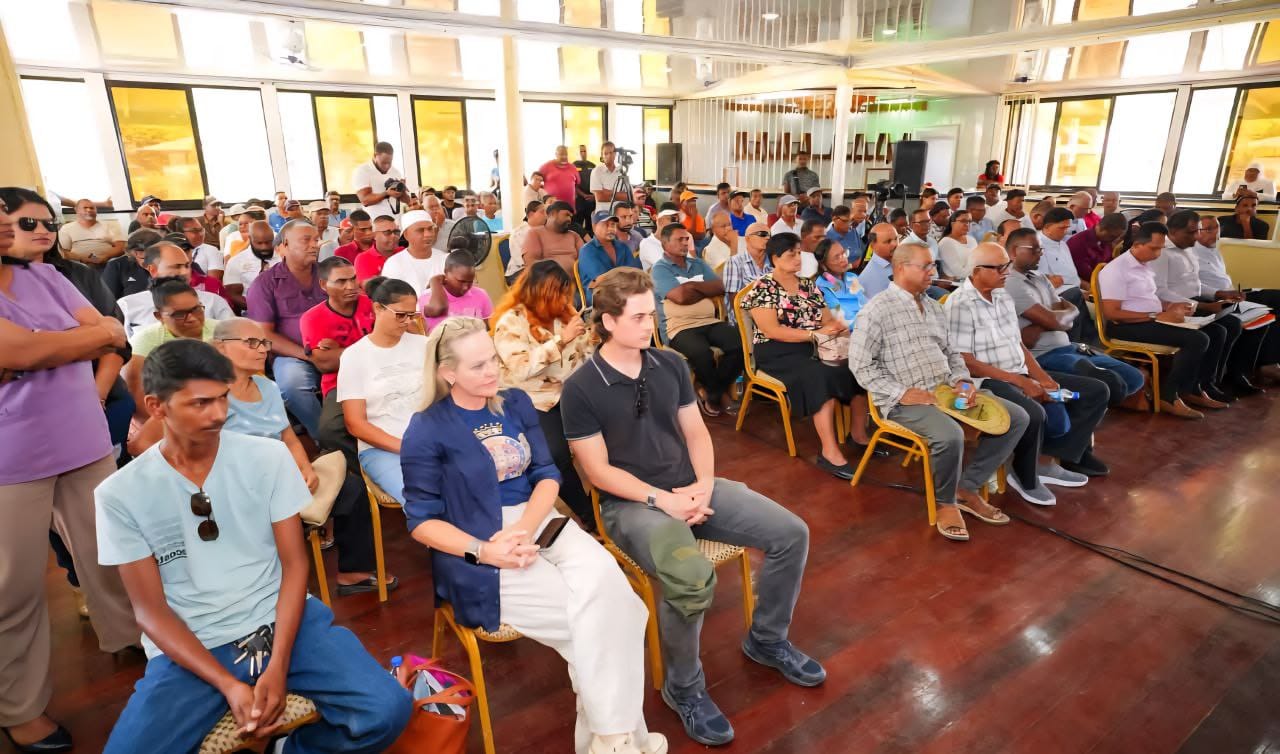
“We are fully aware that the process of mechanisation and system improvement must continue at an even more rapid pace,” he said.
President Ali further explained that private cane farmers currently hold between 8,000 and 12,000 acres of land, which can be used for new production opportunities.
President Ali also highlighted that some farmers are already making significant progress, citing the example of one farmer who cultivates 400 acres of citrus.
According to the President, such examples demonstrate the vast potential that can be realised when farmers and the government work collaboratively.
He assured that the government will continue to fulfil its role in creating an enabling environment for agricultural growth.
This commitment includes investments in drainage and irrigation systems, road networks, and other critical infrastructure.
However, President Ali emphasised that these initiatives must be accompanied by enhanced productivity in order to fully harness the sector’s potential.
“We can’t have investments being made and land being idled,” President Ali told the farmers.
To support this initiative, President Ali announced that soil samples will be collected from all available agricultural lands within the next week.
According to him, these samples will undergo comprehensive laboratory analysis to determine the most suitable crops for each area, and the results will then be made accessible digitally via a dedicated website.
This, he explained, will provide both farmers and investors with convenient access to this valuable information.
Furthermore, President Ali stated that the government is engaged in active discussions with both local and international partners.
He specifically mentioned ongoing talks with Demerara Distillers Limited (DDL), which has expressed interest in investing in a juice processing plant in Skeldon, contingent upon farmers committing to citrus cultivation.
According to the President, DDL has indicated that the plant could be operational within as little as 12 months.
In addition, investors from Roraima are collaborating with the government on crop initiatives, including citrus and coffee, while partners from the Dominican Republic are preparing to introduce technology for co-investment projects.
Additionally, the President also highlighted a significant cocoa project set to be launched soon in the Pomeroon area.
According to him, farmers in Skeldon were told that several options are on the table, including two proposals for re-establishing a sugar factory.
However, he cautioned that such an investment would require a clear long-term pricing system to give investors confidence, adding that they have to justify their investment over a long-term period.
President Ali further noted that coconut farming has been identified as a promising opportunity, given the increasing global demand for the crop.
Currently, Region Two boasts 3,000 acres of new coconut plantations, and Skeldon has the potential to follow this example.
The President also indicated that testing will be conducted to assess the viability of coffee cultivation in the area, citing Roraima’s success in achieving production within two years.
President Ali emphasised that the plan must adopt a multi-pronged approach, with various crops cultivated on a large scale to ensure production is both profitable and sustainable.
He stated that the next steps involve convening a representative group of cane farmers, the Ministry of Agriculture, private investors, and international partners, including those from Roraima and the Dominican Republic, to develop and agree on a long-term strategy.
Finally, President Ali stated that the meeting is expected to take place within 14 days, following the completion of soil mapping and analysis.
He also added that the Minister of Tourism, Industry and Commerce, Susan Rodrigues, will also participate in the discussions to help establish strong connections to markets and trade opportunities.
President Ali stressed that this agricultural push would require full commitment, not only from the government, but also from farmers and the private sector.
He made it clear that idle land or half-hearted efforts will not be accepted if the long-term vision is to succeed.
“This is going to be 24-hour work, 24-7, for us to get where we want to be,” President Ali said.
With opportunities spanning citrus juice production, sugar industry revitalisation, coconut cultivation, and new ventures in coffee and cocoa, President Ali expressed confidence that Skeldon could once again become a key driver of growth in Guyana’s agricultural sector.
He urged farmers to embrace the broader vision and fully commit to the transformation process, assuring them that the government will continue to provide the support and infrastructure needed to make that vision a reality.