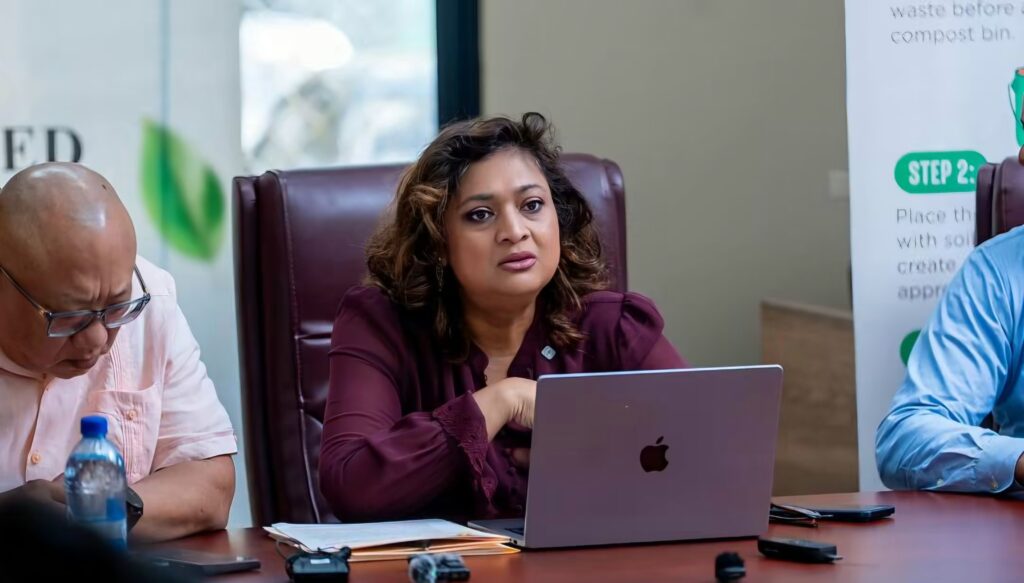
Garbage collection contractors in Georgetown will now be required to adhere to their scheduled collection days or bear the cost of alternative services, following the removal of a longstanding 48-hour grace period, Minister of Local Government and Regional Development Priya Manickchand announced on Thursday.
While speaking with the media at her press conference yesterday, the Minister outlined a series of measures to address longstanding problems in the capital’s waste management system, including delayed garbage collection, inadequate monitoring and the emergence of illegal dumping hotspots.
Minister Manickchand shared that following several rounds of discussions with contractors attached to the Mayor and City Council (M&CC), an agreement was reached to eliminate the 48-hour grace period previously allowed for garbage collection.
Under the revised arrangement, she explained that contractors must collect garbage on their designated days.
The Minister also noted that if a contractor fails to fulfil that obligation, the Ministry of Local Government and Regional Development will engage an alternative service provider to undertake the collection, with the cost passed on to the defaulting contractor.
Moreover, Minister Manickchand explained that the previous arrangement, which permitted collections to be delayed by up to two days, had contributed to unsanitary conditions in communities.
She added that garbage left uncollected often produced foul odours and attracted flies, rodents and stray dogs, creating additional discomfort for residents.
Although responsibility for domestic waste collection and disposal rests with the Mayor and Councillors of the City of Georgetown (M&CC), Manickchand said several deficiencies in the system had been identified during her first year in office.
Among them was the discontinuation of parapet waste collection around 2016–2017, which resulted in garbage being left along roadside parapets across the capital.
Another concern was the lack of adequate monitoring of contracted garbage collection services.
According to the Minister, authorities had relied heavily on complaints from residents, particularly those posted on social media, to determine when scheduled collections had not taken place.
Population density has also placed additional pressure on the system, with some constituencies generating enough waste to require a second round of garbage collection.
The growing demand for waste disposal services is reflected in the volume of garbage received at the Haags Bosch landfill.
Minister Manickchand further reported that when the facility began operations, approximately 150 tonnes of waste were disposed of daily, with around 60 trucks transporting garbage to the site.
That figure has since increased to approximately 2,000 tonnes daily, delivered by more than 420 trucks, despite the establishment of additional disposal sites in other regions.
Furthermore, the Minister also addressed the development of illegal dumping hotspots across Georgetown, where certain locations had increasingly come to be regarded as unofficial garbage disposal sites.
While detailing these problems, Manickchand stressed that the purpose of identifying the deficiencies was to determine how they could be addressed, rather than simply assign blame.
“I want to be very clear here: the identification of these problems is just an identification of what it is that is problematic that we have to fix,” the minister said.
“It is not to sit here and necessarily blame anybody, although it is the city who is responsible, so they are blameworthy, but that is not the purpose of this [press conference].
The purpose of this [press conference] is to tell you what the problems are and what the solutions are.”
Alongside the revised contractor arrangements, the Minister explained that the Ministry is introducing additional measures intended to improve the reliability of garbage collection and strengthen oversight across Georgetown.
According to her, one of the measures involves establishing and publishing collection schedules so that residents know when their garbage should be collected and which contractor is responsible for servicing their area.
She also related that informational flyers will be distributed to every household in the capital, outlining the scheduled collection days and times for domestic garbage, arrangements for parapet waste removal and contact information for the Ministry.
Furthermore, the Minister explained that the initiative is intended to make it easier for residents to report missed collections and hold service providers accountable.
Speaking on improving monitoring, Minister Manickchand stated that the Ministry also plans to recruit 15 community service providers who will be assigned to constituencies across Georgetown.
She said these personnel will monitor garbage collection and disposal activities while providing regular updates on conditions within their communities, particularly where service delivery is concerned.
Each community service provider will be equipped with an electric bicycle valued at $65,000 to facilitate movement throughout their assigned areas.
Meanwhile, the Ministry is also deploying vehicles and heavy-duty equipment from its existing fleet to support garbage collection, particularly in densely populated communities and during periods of increased demand.
The equipment includes Canter trucks, dump trucks, low-bed trucks, mini excavators, Hiab trucks and garbage collection vehicles.The additional operations will also involve expenditure for drivers and porters.
Additionally, Minister Manickchand noted that in communities such as Sophia, garbage collection services have already been introduced through collaboration involving private contractors, the M&CC and the Ministry of Local Government and Regional Development.
She also shared that more than 30 skip bins have been temporarily placed at identified dumping hotspots across Georgetown in an effort to provide residents with designated locations for waste disposal.
Manickchand explained that the placement of the bins is intended to discourage indiscriminate dumping and encourage more responsible waste disposal practices as regular collection services are strengthened in residential and commercial areas.
Finally, Minister Manickchand said the measures are intended to improve garbage collection, strengthen monitoring and ensure greater accountability among contractors, while encouraging residents to play a more active role in maintaining a cleaner Georgetown.